Landscaping Done Right: Sod, Hydroseeding and Plantings Built to Establish and Hold
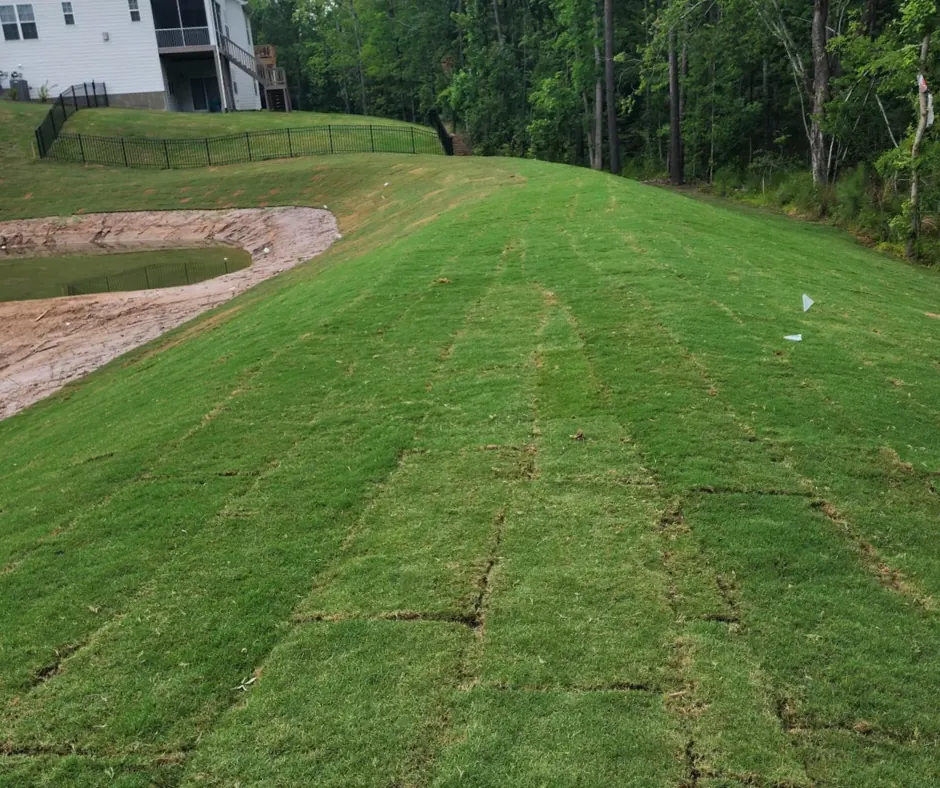
On a development site, landscaping is often treated as the last line item on the punch list, the thing that happens after the real work is done. In practice it is its own scope, with its own specs, its own inspection points and its own way of going wrong if it is rushed. For developers and general contractors, getting landscaping right is what turns a graded lot into a finished, sellable site.
Landscaping covers more ground than people expect
“Landscaping” on a construction site is not just a few shrubs by the entrance sign. It typically covers:
- Entrance and common-area landscaping for HOAs and subdivisions, where first impressions and long-term maintenance both matter.
- Buffers and common open space (COS), which often carry their own permit conditions for vegetation type and coverage.
- Residential lots, where sod and plantings are part of closing out an individual home.
Each of these has a different spec, a different inspector expectation, and a different timeline, which is why treating landscaping as a single generic task is where a lot of projects lose time.
Sod versus hydroseeding versus permanent seeding
The three main ways to establish a lawn each fit a different situation.
Sod installation gives you an instant, stable lawn. It is the right call for entrances, model homes and any area that needs to look finished immediately, but it depends on tight seams and consistent watering to actually root.
Hydroseeding sprays a slurry of seed, mulch and tackifier over larger areas fast. It is efficient for common open space and buffers where full sod coverage is not practical, and it establishes faster and more evenly than dry broadcast seeding.
Permanent seeding (seed, straw and tack) is the standard for large graded areas and slopes where the goal is long-term, low-maintenance cover rather than an immediate finished look.
None of these is universally “better.” The right choice depends on the area’s size, its visibility, its slope and how soon it needs to hold.
What a landscaping crew actually does
Good landscaping on a job site is a sequence, not a single visit:
- Site and soil prep. Grading to final elevations and preparing a bed that can actually support root growth.
- Plant and grass selection. Matching species to the site’s sun, soil and drainage, and to whatever the plan or HOA covenant requires.
- Installation. Sod laid tight with no gaps, hydroseed or seed applied at the right rate, plantings set at correct spacing and depth.
- Mulch beds. Defined, edged beds around entrances and structures that hold moisture and keep weeds down.
- Watering and establishment. The step that decides whether everything before it survives its first month.
- Follow-up. Checking for bare spots, dead plantings or wash-outs before they become a warranty call.
Sod that is laid tight and watered in will hold almost immediately. Hydroseed that is applied and forgotten will wash out with the first storm. The difference is the follow-through.
Landscaping and erosion control still work together
Landscaping does not stop being erosion control just because the site looks finished. Established sod and plantings filter runoff, hold soil on slopes and reduce sediment leaving the property, which is exactly why permanent seeding and sod show up in site stabilization plans and on pond conversion slopes and buffers. The two scopes are related, but landscaping is a service in its own right, with its own crew, materials and schedule.
Where landscaping goes wrong
Most landscaping call-backs trace back to the same handful of shortcuts:
- Sod laid on unprepared or compacted soil, so it never roots.
- Hydroseed or seed applied without straw or tack, so it washes out before it germinates.
- Plantings set without matching the site’s actual sun and drainage conditions.
- No one walking the site again after installation, so a dead patch sits there until a resident or inspector flags it.
Avoiding all of it comes down to treating landscaping as a full scope, not an afterthought, with the same planning you would give any other part of the site.
The bottom line
Landscaping is where a project either locks in a finished, sellable look or quietly generates its next round of warranty calls. Match the method (sod, hydroseed or seed) to the area, prep the ground properly, and follow up until it is actually established.
Working on entrances, buffers, common open space or residential lots around Wake County and Eastern North Carolina? Give us a call and we will help you plan a landscaping approach built to establish and hold.
Have a site that needs attention?
Delcid handles erosion control, stormwater, site stabilization, landscaping and street washing across North Carolina. The fastest way to reach us is a call.